
1.1 Why Good Businesses Stall: The Inflection Point Every Founder Encounters
Part 1/4 of Series: Inflection Points & Foundational Clarity
Every founder eventually reaches the point where the business they built begins to outgrow the way they run it.
Every founder reaches a moment where the business that once felt energised, fast‑moving, and full of possibility suddenly becomes harder to run. Decisions take longer. Margins tighten. Teams become stretched. Reporting becomes inconsistent. Growth feels less like momentum and more like pressure.
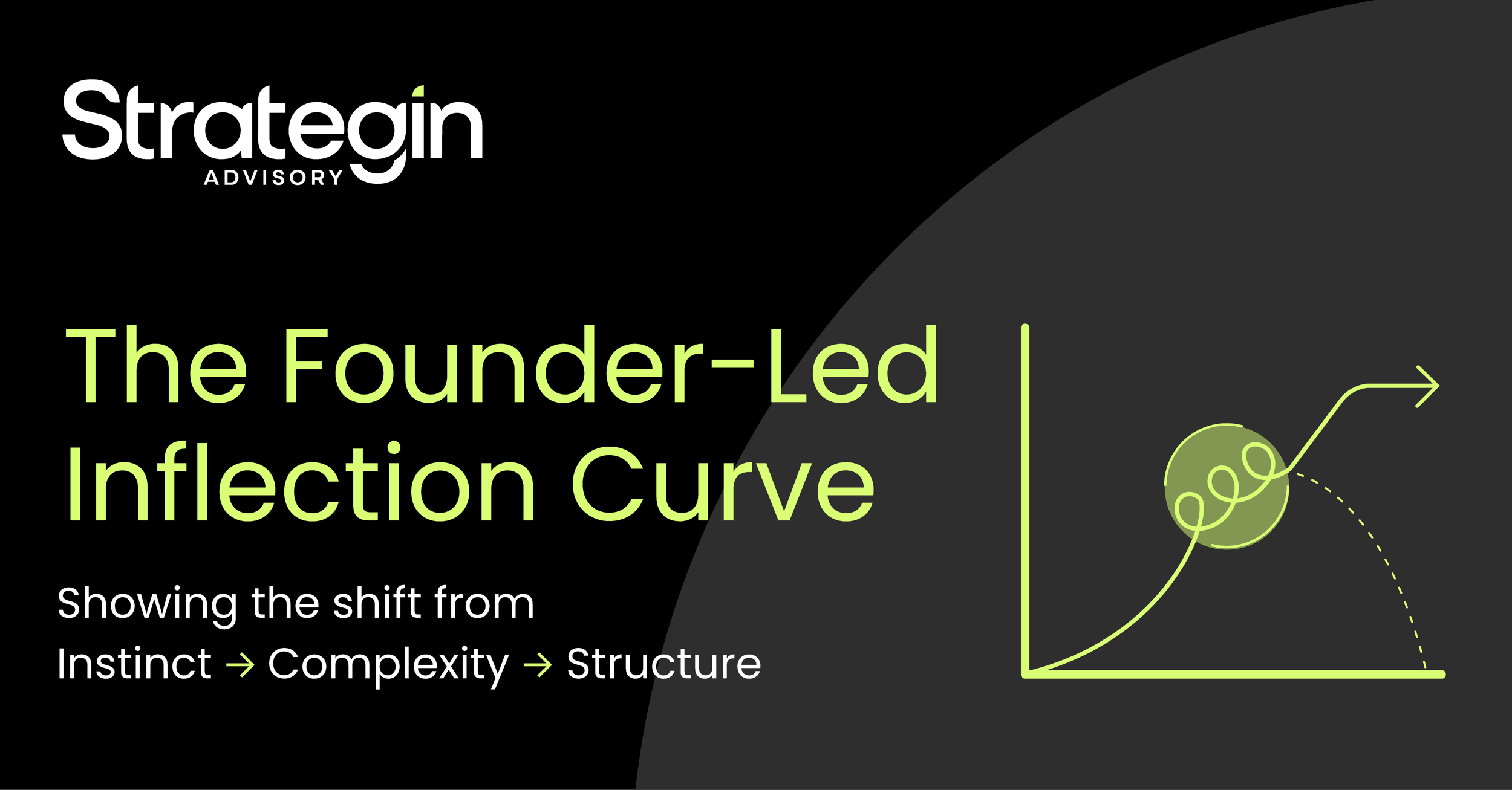
This is the inflection point — the moment where the business outgrows the way it currently operates.
It’s not a failure. It’s a natural stage in the evolution of every founder‑led organisation. But it’s also the point where many businesses stall, plateau, or drift into reactive mode because the founder is still trying to run a larger, more complex business with the same tools, rhythms, and structures that worked when the business was smaller.
Why It Happens
Most mid‑market and founder‑led organisations grow faster than their internal systems. Revenue increases. Headcount expands. Customer expectations rise. But the underlying operating model — governance, reporting, decision rights, commercial discipline, and business rhythm — doesn’t evolve at the same pace.
I often see a business double revenue in three years while still running on the same informal reporting, loosely defined roles and founder-driven decision making that worked at half the size.
The result is predictable:
The founder becomes the bottleneck. Every decision flows through one person.
Teams operate without clarity. Roles blur, accountability weakens, and execution becomes inconsistent.
Margins erode quietly. Pricing drifts, costs creep, and operational inefficiencies compound.
Reporting becomes unreliable. Leaders make decisions without the right information at the right time.
Growth becomes chaotic instead of strategic.
This is the moment where founders feel the weight of the business shift from exciting to exhausting.
The Hidden Cost: Founder Load
When the business outgrows its structure, the founder absorbs the pressure. They become the default problem‑solver, the escalation point, the commercial conscience, and the operational safety net.
This is unsustainable — and unnecessary.
Most founders don’t realise they have become the bottleneck until exhaustion or a missed opportunity forces the realisation.
The real issue isn’t the founder. It’s the operating model.
The Shift That Unlocks the Next Phase
Businesses that break through this inflection point do one thing differently: they evolve from founder‑reliant to system‑reliant.
This is not about adding bureaucracy. It is about replacing dependency with discipline.
This shift requires:
Clear governance — who decides what, and on what basis.
Commercial discipline — pricing, product clarity, margin control, and performance rhythms.
Operational routine — predictable weekly, monthly, and quarterly cycles.
Financial control — reporting that is timely, accurate, and decision‑ready.
Leadership clarity — roles, accountability, and expectations that support scale.
When these elements are in place, the founder regains altitude. The business regains momentum. And growth becomes intentional rather than accidental.
Why This Matters Now
The mid‑market environment is shifting.
Investors are more selective.
Customers expect more.
Margins are under pressure.
Operational complexity is increasing across every sector.
In this environment, informal management and founder instinct is no longer enough.
Founders who recognise the inflection point early — and respond decisively — create organisations that are resilient, scalable, and attractive to investors or acquirers.
Those who ignore it, often find themselves stuck in a cycle of firefighting, fatigue, and diminishing returns.
The Opportunity
The inflection point is inevitable. Stagnation isn’t. The difference is whether the operating model evolves in time.
An inflection point isn’t a warning — it’s an invitation.
It’s the moment to step back, reset the operating model, and build the structure that enables the next phase of growth, investment, or exit.
This is where strategic and operational advisory becomes a catalyst — not to add bureaucracy, but to create clarity, confidence, and commercial strength.
The organisations that thrive are the ones that treat this moment not as something to survive, but as a turning point to leverage.
Is your business at an inflection point? Get in touchwith the team at Strategin Advisory today for a free discussion about your business.
#FounderLeadership #ScaleUpStrategy #MidMarketGrowth #BusinessStabilisation #OperationalExcellence #ExecutionDiscipline #BusinessPerformance #LeadershipClarity #CommercialExcellence #StrategicExecution #ValueCreation #StrateginAdvisory #BusinessPerformance #OperationalExcellence #BusinessCapability #GrowthLeadership #BoardGovernance #RiskManagement #OrganisationalHealth #ValueCreation #GovernanceExcellence #InvestmentReadiness #AcquisitionStrategy #OperationalUplift