
2.1 The 90‑Day Reset: Regaining Control in Turbulent Periods
Part 1/4 of Series 2: How Businesses Regain Control, Rebuild Confidence & Restore Momentum.
Every organisation hits a period where performance slips, clarity fades, and the business feels harder to run than it should. Revenue may still be coming in, but the underlying signals are unmistakable: margin pressure, operational inconsistency, leadership fatigue, and a founder who is increasingly pulled into the weeds.
This is the moment where a structured 90‑day reset becomes not just useful, but essential.
A 90‑day reset is a deliberate, time‑bound intervention that stabilises the business, restores confidence, and rebuilds momentum. It is not a cosmetic exercise. It is a disciplined, commercially grounded process that brings order to chaos and gives the organisation a clear path forward.
Why 90 Days Works
Ninety days is long enough to diagnose, design, and embed meaningful change — but short enough to maintain urgency, focus, and accountability. It forces clarity. It forces prioritisation. And it forces leadership alignment.
Most importantly, it creates a psychological shift: the business moves from reacting to leading.
The Three Phases of a 90‑Day Reset
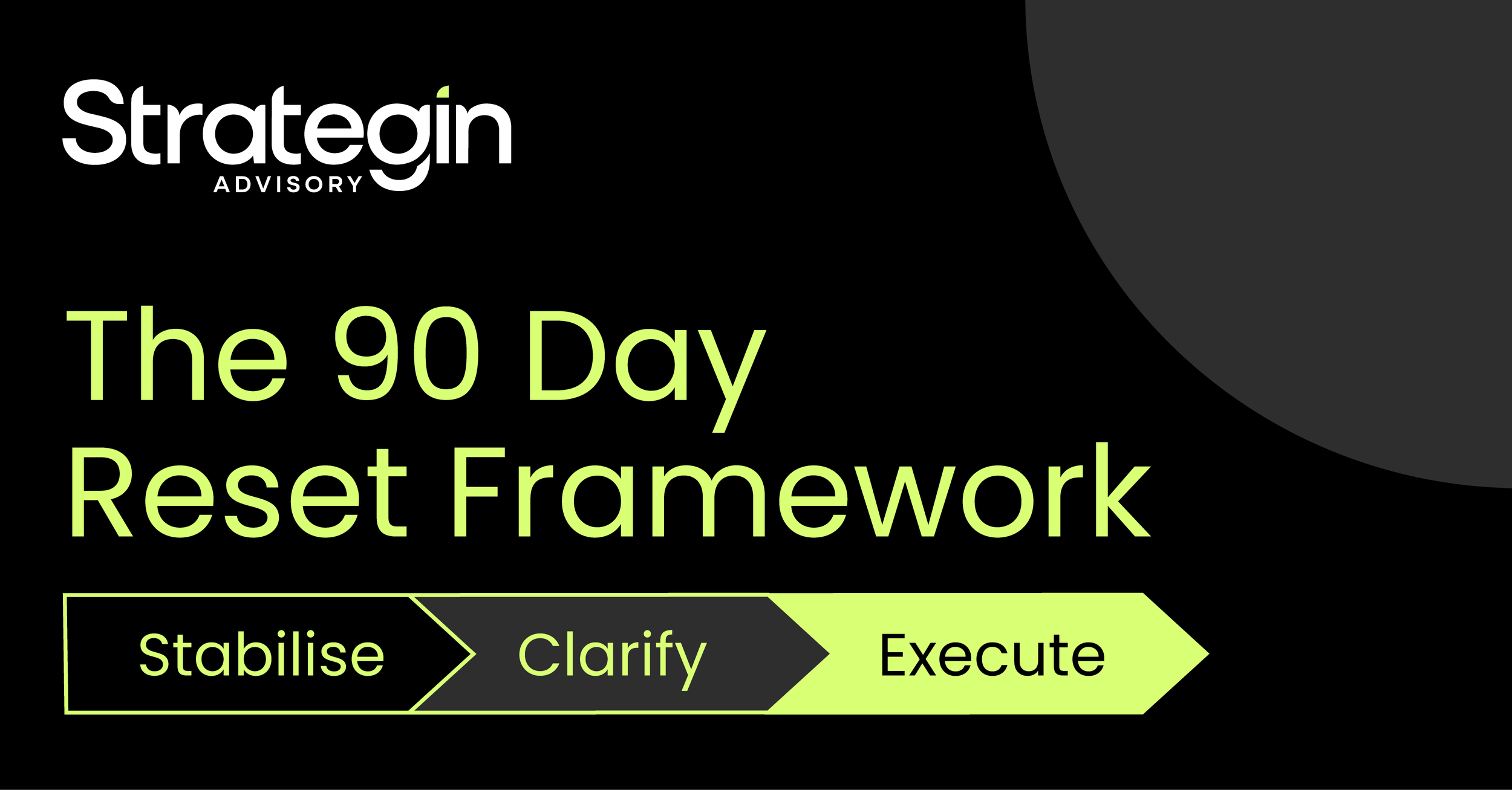
A true reset is not about working harder. It’s about working with precision. The most effective 90‑day programs follow a structured three‑phase model:
Phase 1: Diagnose & Stabilise (Weeks 1–3)
This phase is about truth‑finding. Not opinions. Not assumptions. Facts.
The goal is to understand:
Where value is leaking
Where accountability is unclear
Where processes are breaking
Where reporting is unreliable
Where the founder is carrying too much load
This is where you establish the baseline. You identify the critical issues that must be addressed immediately — cash, customers, compliance, and capability.
Stabilisation activities often include:
Rapid cashflow visibility
Margin and pricing review
Leadership alignment sessions
Operational bottleneck mapping
Immediate risk mitigation
The outcome is clarity: what’s broken, what’s at risk, and what must be fixed first.
Phase 2: Design & Build (Weeks 4–8)
Once the business is stabilised, the focus shifts to building the systems, structures, and rhythms that will carry the organisation forward.
This phase includes:
Redesigning the operating rhythm
Clarifying roles and decision rights
Strengthening financial reporting
Establishing commercial cadence
Streamlining processes
Removing founder dependency
This is where the organisation begins to feel different. Meetings become purposeful. Reporting becomes reliable. Leaders understand their roles. The founder regains altitude.
The business moves from reactive to intentional.
Phase 3: Execute & Embed (Weeks 9–12)
The final phase is about execution and behavioural change. Systems only work if people use them. Cadence only sticks if leadership reinforces it. Commercial discipline only holds if it becomes part of the culture.
This phase focuses on:
Embedding new rhythms
Coaching leaders
Monitoring performance
Adjusting processes
Reinforcing accountability
Celebrating early wins
By the end of 90 days, the organisation has a new operating model — one that is stable, predictable, and ready for growth, investment, or transaction.
Why Founders Need a 90‑Day Reset
Founders often know something is wrong long before they can articulate it. They feel the pressure. They see the symptoms. But they lack the time, bandwidth, or distance to diagnose the root causes.
A 90‑day reset gives founders:
Clarity
Control
Confidence
Capacity
Commercial discipline
It creates the conditions for strategic thinking rather than constant firefighting.
The Real Outcome
A 90‑day reset is not about fixing everything. It’s about fixing the right things — the structural levers that unlock performance and protect value.
When done well, it becomes the turning point that defines the next chapter of the business.
Are you or your business looking to press that 90 day reset button? Get in touch with the team at Strategin today for a free consultation on your business.
#90DayReset #LeadershipClarity #BusinessStabilisation #OperationalExcellence #StrategicExecution #MidMarketGrowth #CFOLeadership #COOLeadership #ChangeLeadership #OrganisationalHealth #BusinessPerformance #StrateginAdvisory #BoardGovernance #RiskManagement #OrganisationalHealth #GovernanceExcellence #ValueProtection #FounderLeadership #ExecutionDiscipline #ScaleUpStrategy #BusinessCapability #LeadershipClarity #AgedCareLeadership #AgedCareReform #CareSectorGovernance #OrganisationalHealth #MidMarketGrowth #BusinessPerformance #CommercialExcellence